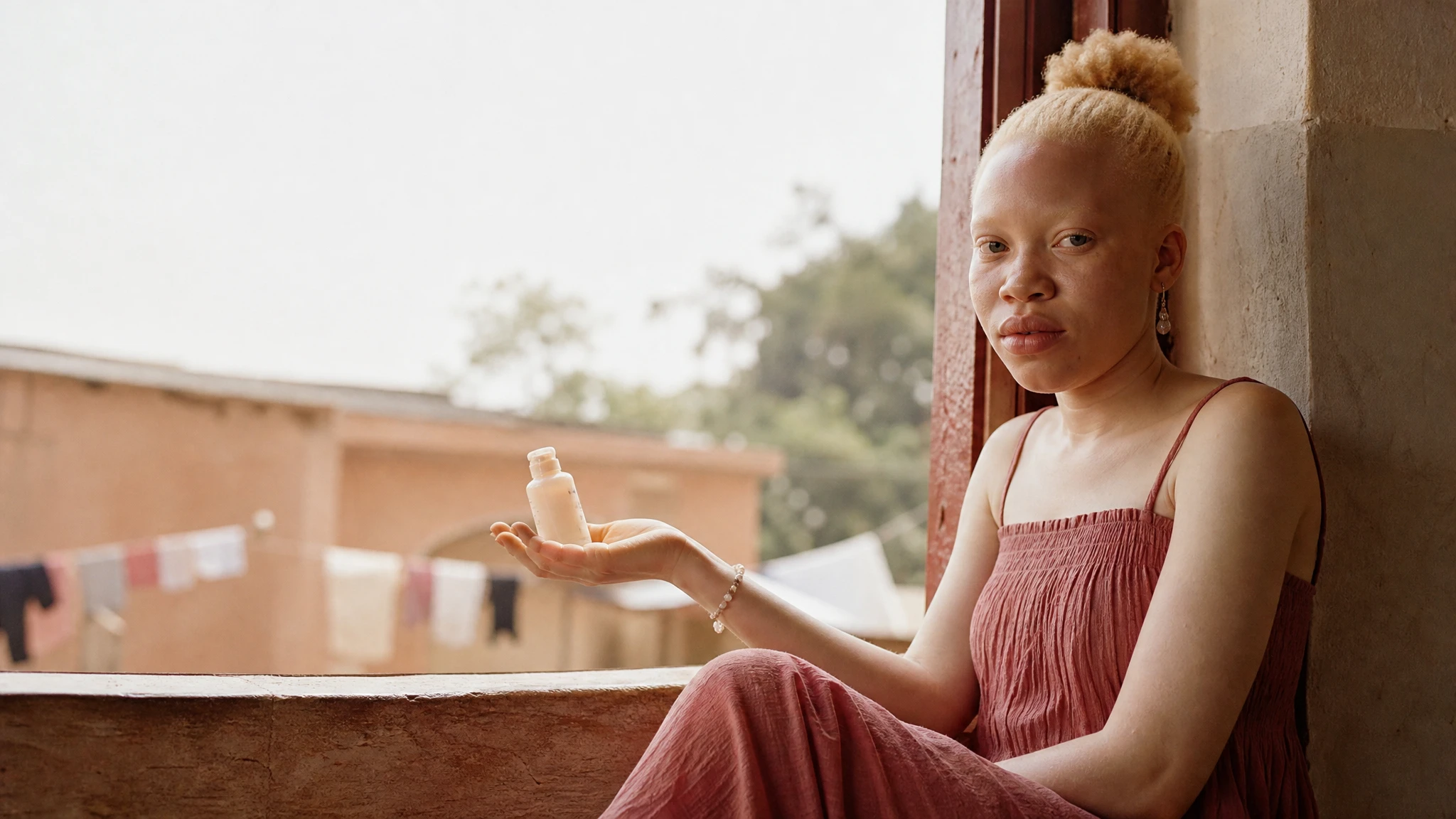
People with albinism in Uganda are calling for specialised healthcare and the removal of import taxes on sunscreen, a daily necessity for skin protection.
In Uganda, sunscreen is not a cosmetic. For people with albinism, it is a medical requirement — applied daily to slow skin damage that, without protection, can progress to cancer within decades.
At a gathering reported by the Daily Monitor, people with albinism formally demanded two things from government: access to specialised dermatological and ophthalmological care, and the removal of taxes on sunscreen products. Both requests reflect the same gap: that the health system does not yet treat albinism as a condition requiring sustained, specific support.
The cost of protection
Sunscreen remains prohibitively expensive for many Ugandan families, the Daily Monitor reported. Because people with albinism produce little or no melanin, their skin has no natural defence against ultraviolet radiation. Without daily high-SPF protection, the risk of sunburn, chronic skin damage, and squamous cell carcinoma rises sharply — a pattern documented across Sub-Saharan Africa, where dermatological services are sparse and sun exposure is year-round.
Representatives at the gathering described sunscreen not as a want but as a prescription-equivalent product. Taxing it, they argued, places a financial penalty on a medical need.
Vision care and the broader ask
Beyond sun protection, those gathered also called for dedicated eye care services, the Daily Monitor noted. Nystagmus, photophobia, and reduced visual acuity are common among people with albinism, yet specialist optometry and ophthalmology remain difficult to access in many parts of Uganda, particularly outside Kampala.
The demand for specialised healthcare pathways points to a structural problem: general health services are rarely configured to address the overlapping dermatological and visual needs that albinism presents. Advocates at the meeting said the gap forces families to pay out of pocket for care that should be covered, or to go without.
The calls follow a pattern visible across East Africa. In Tanzania and Malawi, organisations have made similar arguments to their governments about sunscreen taxation and medical access — with mixed results. Uganda's advocacy community is now pressing for the same ground to be covered domestically.
The Daily Monitor did not report a government response to the demands at the time of publication.
The requests are specific and costed. What follows them will depend on whether policymakers treat albinism as a dermatological and visual health priority, or continue to leave it outside the frame.
Keywords
Core topics and entities mentioned in this summary.