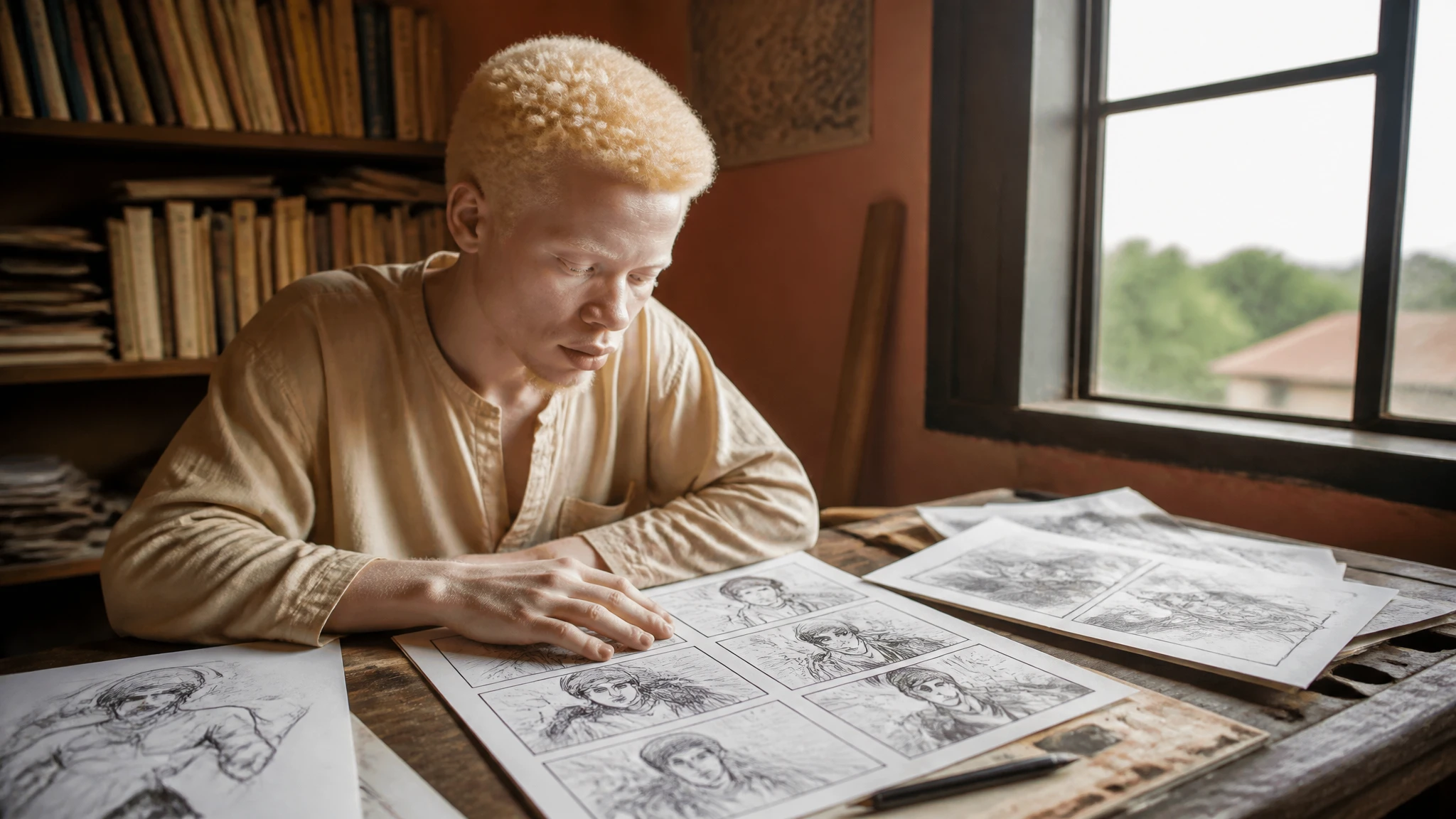
Illustrator Etubi Onucheyo created Albino Boy and the Warriors of Light to counter the myths that drive ritual killings of people with albinism in Nigeria.
A single comic book panel shows a young person with albinism standing at the centre of the frame, not as a victim, not as a curiosity, but as the hero of the story. That image is the deliberate choice of Etubi Onucheyo, a Nigerian illustrator who created Albino Boy and the Warriors of Light to push back against beliefs that cost people with albinism their lives.
Ritual killings of people with albinism occur across parts of sub-Saharan Africa, driven by the belief that their body parts carry magical properties, according to Reuters. Nigeria is among the countries where such attacks have been recorded. Onucheyo, who has albinism himself, told Reuters he wanted to create something that placed people with the condition inside a heroic story — not outside it.
"People with albinism are seen as lesser, as cursed," Onucheyo told Reuters. The comic, he said, was designed to reach children before those ideas take hold.
Storytelling as a counter-narrative
The publication targets young Nigerian readers. Onucheyo told Reuters that representation at an early age shapes how communities understand difference, and how people with albinism understand themselves. The characters fight, lead, and make decisions. They are not defined by their pigmentation.
Under Voices Africa, an organisation Onucheyo founded, the comic has been distributed in schools, according to Reuters. The goal, Reuters reported, is to reach communities where myths about albinism circulate most persistently — and where children with albinism grow up bearing the weight of those myths.
The project sits alongside broader regional efforts. The United Nations and organisations including Under the Same Sun have documented ritual attacks on people with albinism across East and West Africa for more than a decade. Nigeria, Reuters noted, has seen its own cases, though data on the true scale remains incomplete.
Onucheyo's approach is cultural rather than legislative. Where advocacy campaigns address governments and courts, his comic addresses a child sitting in a classroom. Both are necessary. Neither is sufficient alone.
The characters in the series carry their albinism visibly — pale skin, light eyes — and the story does not treat those features as problems to be explained. They are simply part of who the heroes are.
For children with albinism reading the comic, that quiet fact may carry more weight than any awareness campaign.
Keywords
Core topics and entities mentioned in this summary.