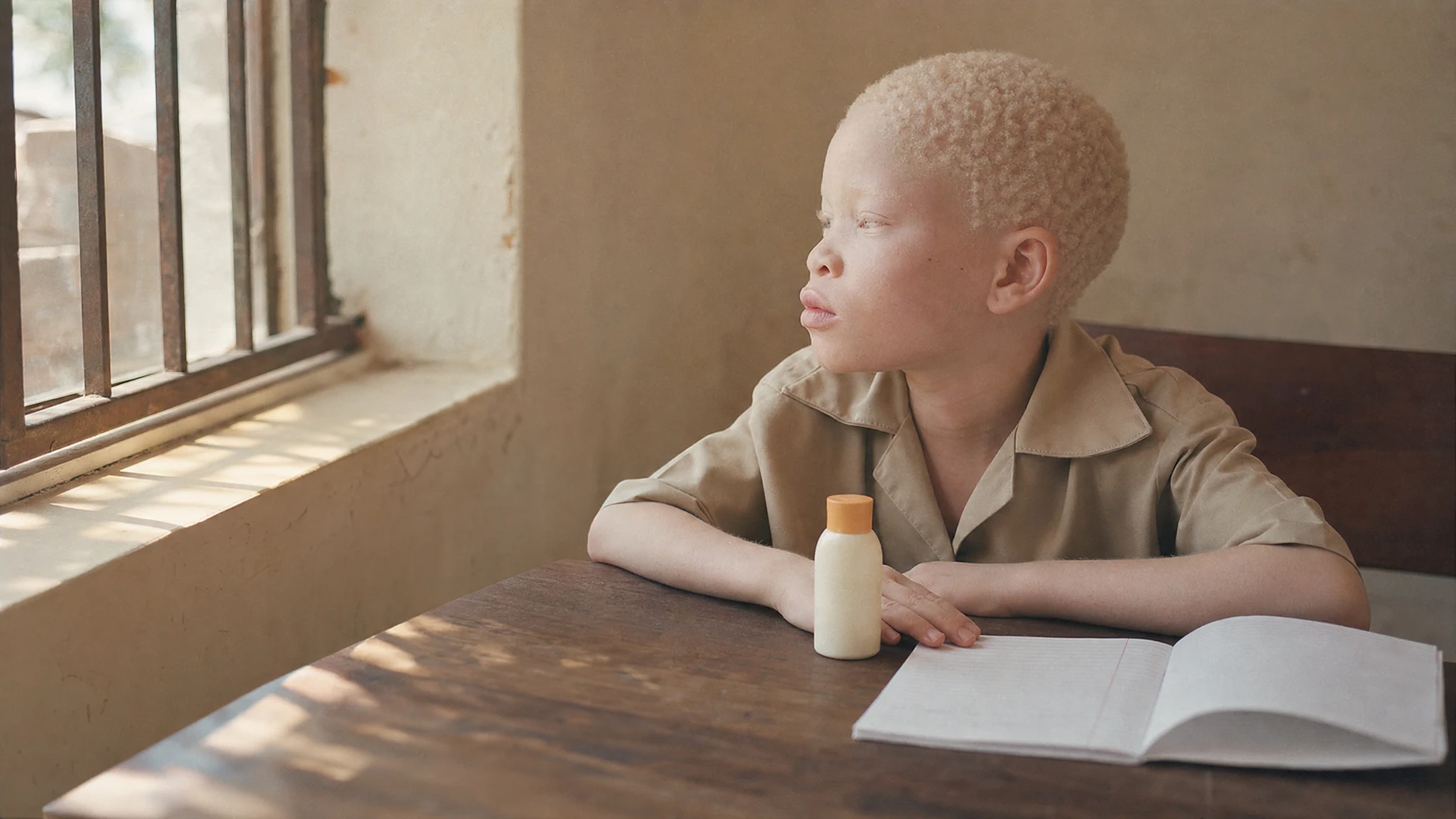
A national conversation is growing around dermatology access, vision support, and school inclusion for South African children with albinism.
In South Africa, a child with albinism is born into a climate that demands SPF 50 every morning — and into a healthcare system that has rarely made that possible without cost or distance.
A recent report by IOL examines how that is beginning to change, as clinicians, educators, and community organisations push for more coordinated care for children with albinism across the country.
Sun protection as a clinical priority
Dermatologists quoted in the report describe skin cancer risk in people with albinism as significantly elevated, with sun exposure starting in infancy and compounding over a lifetime. Access to high-factor sunscreen remains uneven, particularly in rural provinces, where public health facilities do not consistently stock it as a prescribed item, the report notes.
One specialist told IOL that the gap between clinical recommendation and actual access is wide: children are advised to apply SPF 50+ daily, but many families cannot afford to buy it privately and are not routinely supplied through public channels.
Early dermatological screening, the report argues, is the intervention most likely to reduce long-term harm — and it is currently available to very few children outside major urban centres.
Vision, school, and the case for early intervention
IOL also reports on the visual impairments associated with albinism — including nystagmus and photophobia — and their direct effect on learning. Children who cannot access low-vision support early are more likely to fall behind in school, according to educators and vision specialists cited in the piece.
The report describes several programmes working to close this gap, including mobile eye-care outreach and the provision of tinted lenses through selected clinics. These remain small in scale relative to the number of children who need them.
Organisations working in the space told IOL that stigma compounds the medical picture. Families in some communities continue to encounter harmful myths about the cause of albinism, which can delay the moment a child first receives any professional care at all.
Why this matters
South Africa has one of the more developed public health infrastructures on the continent, which makes it a meaningful test case for what integrated care for people with albinism could look like. The IOL report suggests the building blocks exist — dermatology services, low-vision programmes, school inclusion policy — but they have not yet been joined into anything a family can reliably navigate.
For the broader community, that gap is the story. Not the absence of solutions, but the distance between what is known and what is provided.
The report is a quiet reminder that reimagining care requires more than clinical knowledge — it requires the systems that deliver it to treat sun protection and vision support as basic, not optional.
Keywords
Core topics and entities mentioned in this summary.